CINCINNATI — In a city renowned for its chili, its historic architecture, and its passionate sports fans, there’s one “grassroots” activity that often gets a sideways glance, a polite chuckle, or outright disbelief: Hopscotch Yodeling. It’s a niche pursuit, to put it mildly, often dismissed as a whimsical invention or a practical joke, yet it boasts a surprising, if obscure, lineage within certain Cincinnati circles.
Indeed, even within its small community, practitioners are well aware that mentioning “competitive hopscotch yodeling” usually elicits a blank stare, followed by nervous laughter. “People think you’re making it up,” explains Martha “The Maestro” Gable, a veteran yodeler from Clifton who dabbled in the early hopscotch fusion. “They don’t realize the intense focus it takes.”
Humble Beginnings: The Post-War Park Craze
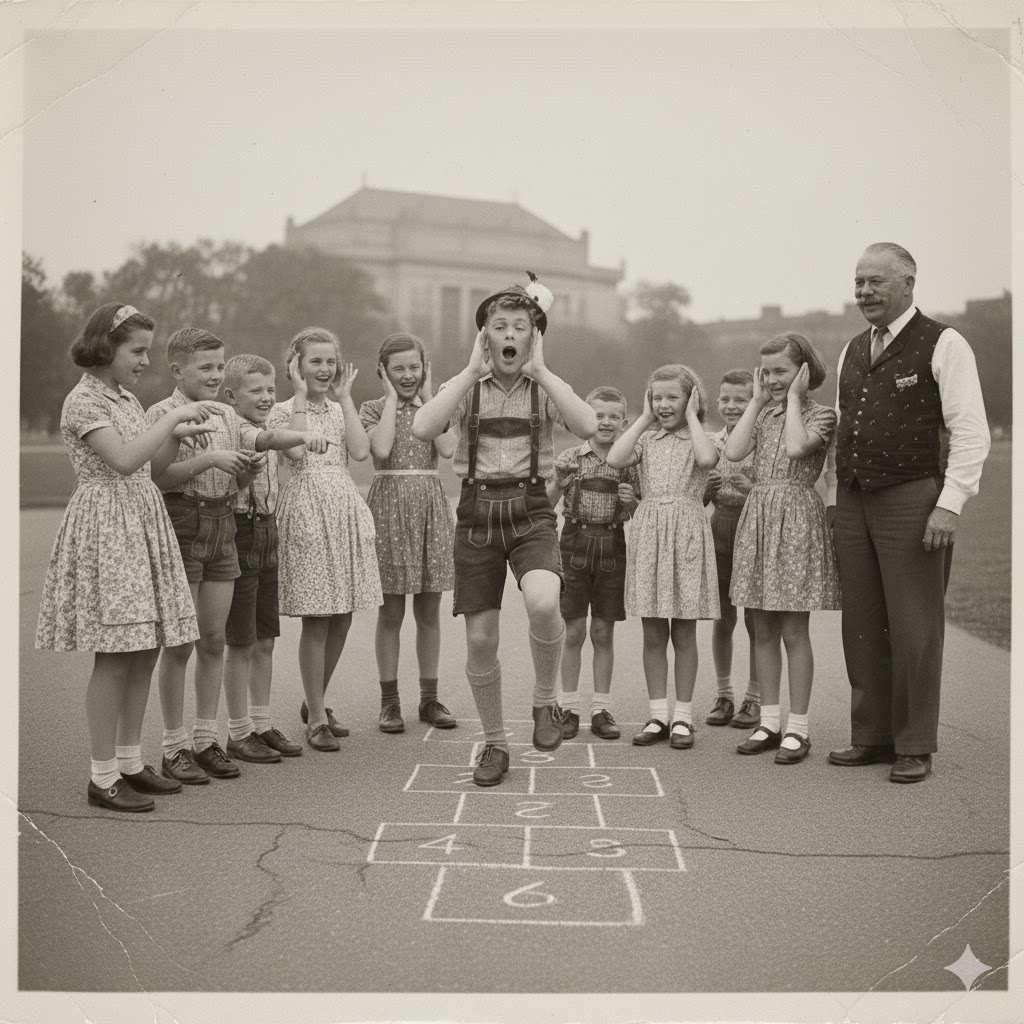
The origins of Hopscotch Yodeling are hazy, often attributed to a convergence of boredom and accidental artistry in Cincinnati’s post-World War II parks. As urban children reclaimed public spaces, hopscotch became a prevalent pastime. Simultaneously, German and Swiss immigrant communities, particularly strong in neighborhoods like Over-the-Rhine and the West Side, kept their traditional yodeling techniques alive.
Lore suggests the first accidental “hopscotch yodel” occurred around 1953 in Washington Park. A young German-American boy, exasperated after tripping during a particularly intense hopscotch game, allegedly let out an involuntary, multi-pitched “yoo-hoo-lay-hee!” while hopping on one foot. A small audience of onlookers found it simultaneously ridiculous and rhythmically compelling.
The “Schuhplattler Hop”: Early Developments
For years, the combination remained a private amusement. It wasn’t until the late 1960s, fueled by the counter-culture movement’s embrace of the unconventional, that it began to formalize. Groups of students and artists in Clifton and Northside, fascinated by the unique challenge, started experimenting. They drew inspiration from traditional Schuhplattler dancing, where rhythmic foot-slapping is combined with yodeling, attempting to translate that percussive vocalization onto the hopscotch grid.
Early “competitions” were informal gatherings in backyards and community centers, judged more on exuberance than technical precision. Participants would attempt to complete a standard hopscotch sequence while maintaining a continuous yodel, often with hilarious results. Broken vocal registers and missed squares were common.
The “Lost Decades” and Near Extinction
The 1980s and 90s proved to be difficult for Hopscotch Yodeling. As urban landscapes changed and youth culture shifted, the sport nearly faded into obscurity. Without formal organizations or consistent venues, it survived primarily through word-of-mouth among a dedicated few who saw its unique charm and challenging nature. “It became something you did at family reunions, more than a competition,” remembers Lil’ Alfy Timberton, the recently dethroned world champion, whose own family kept the tradition alive through generations. “We’d just laugh, mostly.”
The 21st Century Resurgence and Online Curiosity
The digital age, surprisingly, offered a lifeline. The sheer oddity of “Hopscotch Yodeling” made it fertile ground for quirky online content. Short clips shared on early video platforms sparked a new, albeit small, wave of curiosity. It was this burgeoning online interest that inspired newcomers like Eric Sezso to explore the sport, bringing fresh energy and a scientific approach to its overlooked technical demands.
Today, while it still struggles for mainstream recognition and is frequently met with incredulity, the victory of Eric Sezso and the increasing interest from a younger generation suggest that Hopscotch Yodeling might finally be stepping out of the shadows. It remains a testament to Cincinnati’s unique character – a city where even the most unexpected combinations can find a home, and perhaps, a champion.
By Dr. Eleanor Vance, Cincinnati Cultural Historian
 Cincinnati Good News
Leave a comment